

If you want your charcoal grill to settle in around 250°F, plan on roughly 25–50 briquettes for a standard kettle or 22–27″ grill. Use fewer if you’re cooking with lump charcoal or running a tight two-zone setup, and more if conditions are windy or the grill is on the larger side.
A good starting point is about 30 briquettes, then fine-tune by adding or removing 5–10 at a time while keeping an eye on your thermometer.
You’ll quickly see how vent settings, charcoal type, and coal layout influence that number. Techniques like the snake method or a two-zone fire can extend burn time and make holding steady, low heat far more reliable.
Understanding Charcoal Grill Temperatures

You need to control how much charcoal you use and how much air reaches the fire. Your grill’s ability to hold heat is just as important as the fuel itself.
The Science Behind Charcoal Heat
Charcoal produces heat by burning fixed carbon in the briquettes or lump charcoal. Briquettes burn more evenly and longer than lump charcoal, so you often need fewer briquettes for steady temps.
How many charcoal pieces you use depends on grill size; a small kettle needs far fewer briquettes than a large barrel smoker. Heat output also depends on how densely you pack the fuel.
A tight pile yields higher, longer-lasting heat. Spread coals thin and the temperature drops faster.
Watch your temperature gauge and add 5–10 briquettes at a time if it falls below 250°F.
Role of Oxygen and Airflow
Oxygen controls the burn rate. Open the bottom vents and the coals get more oxygen, which raises temperature quickly.
Close vents partially to slow the burn and hold 250°F longer. Use the top vent to fine-tune smoke flow and prevent flare-ups.
Position coals for two-zone cooking: a hot side with most coals and a cooler side with few or none. This helps when you need a stable 250°F for low-and-slow cooks.
If wind is strong, choke vents more or add a windbreak; wind forces oxygen in and can spike temperature.
Impact of Grill Design
Your grill’s shape and materials change how many coals you need. Thick metal or ceramic walls hold heat well, so you can use fewer briquettes to stay at 250°F.
Thin-walled, portable grills lose heat faster and need more charcoal or more frequent topping up. Grill size matters: large cookboxes need more coals to reach and maintain 250°F.
A built-in lid thermometer on the grate level gives a more accurate reading than a lid-mounted gauge. If your temperature gauge reads low, check placement and use a probe thermometer at cooking level to verify actual heat.
How Many Coals for 250 Degrees?

To hit and hold 250°F, you need a predictable coal amount, a clear layout, and a way to tweak airflow. The right number changes with grill size, coal type, and whether you use a measuring cup or chimney.
General Coal Quantities for 250°F
For a standard 22–26 inch kettle or medium smoker, start with about 25–40 briquettes lit and ashed over. Lump charcoal burns hotter and less evenly, so use on the lower end (20–30 pieces) for steady 250°F.
Briquettes burn more consistently, so 30–40 briquettes is a good baseline. Arrange coals in a two-zone or snake layout for long cooks.
Use a chimney starter or lit/unlit mix if you need longer burn time. Monitor with a reliable lid thermometer and add 5–10 briquettes if temperature drops more than 15°F.
Adjustments Based on Grill Size
On small grills (up to 18″ grate) use 15–25 briquettes to reach 250°F. They heat faster and need fewer coals.
On large grills or offset smokers (over 26″ grate) plan 40–60 briquettes or a larger snake to maintain 250°F for hours. Wind, ambient temperature, and lid fit matter.
In wind or cold, increase coal count 10–20%. If your grill leaks air or has poor insulation, add coals or tighten vents.
Always make small adjustments: change vents by 1/8 turn or add 5 briquettes, then wait 10–15 minutes to see the effect.
Estimating with Charcoal Measuring Tools
Use a charcoal measuring cup or scoop to standardize amounts. A typical charcoal measuring cup holds roughly 20–25 briquettes.
That means 1.5–2 cups will usually give you 30–40 briquettes—enough for 250°F on a medium grill. A chimney starter sized for 30 briquettes gives a quick visual guide: one full chimney is often more than you need.
For longer cooks, use a half-lit, half-unlit method or a measuring cup to build a snake and add coals predictably. Keep notes: record cups used, layout, and vent settings so you replicate 250°F next time.
Charcoal Arrangement Methods for 250°F
 Use a two-zone setup, slow-burning starter coals, or a staggered chain of briquettes to hold steady at 250°F. Pick a layout that gives you indirect cooking space, easy coal feeding, and simple vent control.
Direct and Indirect Heat Setups
Set up two zones: one side with coals and one side empty. Place 20–40 briquettes on the hot side depending on grill size, then let them ash over.
Put food on the empty side for indirect grilling to keep the grill near 250°F without flare-ups. Use direct grilling only for searing or short cooks over the coals.
For low-and-slow roasts, keep the lid closed and adjust vents so the bottom vent is partly open and the top vent is slightly open. Monitor a lid or grate thermometer and add a few lit briquettes to the hot side if temp drops.
The Minion Method
Arrange a full bed of unlit briquettes in the charcoal basket. Place 8–16 lit briquettes on top or in a chimney and drop them onto one end.
The lit coals slowly ignite the unlit pile, giving steady heat for many hours near 250°F. This method works well for indirect cooking because it produces a long, slow burn with consistent airflow.
Control temperature by how many lit coals you start with and how full the basket is. Use common-sense vent settings and a probe thermometer for best results.
Charcoal Snake Technique
Lay briquettes in a crescent or ring along the grill wall in a 2:1 or 3:1 overlapping pattern. Light 8–12 briquettes at one end of the snake; the burn travels slowly along the chain and keeps the grill around 250°F for several hours.
The snake method gives you a long, predictable indirect heat source inside a kettle grill. Use this for smoking or long cooks where you need a steady 250°F without constant attention.
Add a few chunks of wood between briquettes for mild smoke. Control vents minimally; the slow burn needs only small oxygen adjustments.
Lighting and Managing Charcoal

You need steady, evenly lit coals and a safe way to start them. Pick a lighting method that gives you control over how fast coals heat and how long they burn.
Using a Charcoal Chimney Starter
A charcoal chimney starter gives quick, even ignition without chemicals. Fill the top chamber with the number of briquettes you plan to use for a 250°F cook.
Place crumpled newspaper or a fire starter under the chimney on the grate or a heat-safe surface. Light the paper in several spots and let the coals heat for 10–20 minutes.
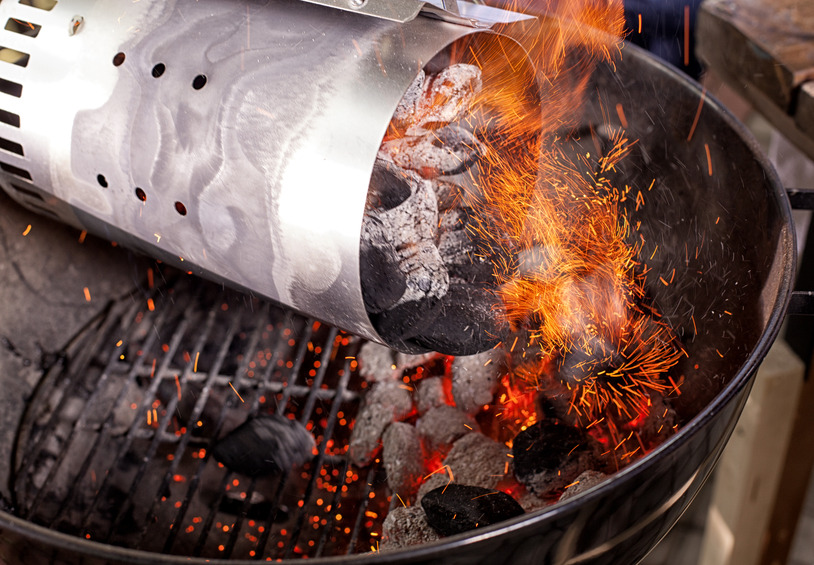
When coals are mostly covered in white ash, pour them into the grill in your chosen layout (single layer, two-zone, snake, or minion). Use tongs or heat-resistant gloves while handling the chimney.
A chimney lets you add only fully lit coals to the grill, so temperature control becomes easier. It also reduces flare risk and avoids fuel taste on food.
Using Lighter Fluid Safely
Lighter fluid can speed things up, but use it with care to avoid flare-ups and chemical taste. Start with charcoal in a shallow mound.
Squirt fluid evenly across the top—do not soak the coals—and wait 30 seconds for it to soak in before lighting. Light from several points using a long match or lighter.
Keep the lid open until flames die down and coals ash over, usually 10–15 minutes. Never add lighter fluid to burning or hot coals; that can cause dangerous flare-ups.
Store fluid away from heat and use only products made for charcoal. If you detect a fuel smell on the coals after they ash, let them burn longer before cooking to avoid off-flavors.
Maintaining a Steady 250°F Temperature

Keep vents slightly open, watch your grill gauge, and add small amounts of charcoal when the temp drops. Small changes to air flow and fuel are easier to manage than big ones.
Vent Adjustments and Air Control
On a Weber kettle, vents control oxygen and thus heat. Start with both vents about 1/8 to 1/4 open for 225–250°F cooks.
After the grill stabilizes (20–30 minutes), tweak the top vent in small steps — about 1/8 turn — to raise or lower temp by roughly 10–15°F. If the temp falls and the top vent no longer helps, open the bottom vent a bit more.
Use small adjustments and wait 15–20 minutes for the kettle to re-stabilize before changing again. Closing vents too far will starve coals and lower temps quickly.
Use a damp cloth or glove when touching vents. Note that wind and lid thermometer placement can affect readings; place the gauge opposite the main vent for a truer cooking-zone reading.
Monitoring with a Temperature Gauge
Use a reliable temperature gauge in the cooking zone, not the lid. Digital probes are faster and more accurate than dial lid thermometers.
Place the probe at grate level near the meat to read the temperature you care about. Watch the gauge for trends, not single spikes.
If the temperature drifts more than 10–15°F, act with vent or fuel changes and allow 15–20 minutes to see the effect. Log readings every 10–15 minutes for long cooks to spot steady declines.
If your Weber kettle’s lid thermometer reads higher than the grate probe, trust the probe. Calibrate any gauge before long cooks by testing it in boiling water (should read about 212°F at sea level).
Adding Charcoal During Cooking
Add charcoal in small, controlled amounts to avoid big temperature jumps. For long 250°F cooks on a Weber kettle, add 5–10 hot briquettes at a time, placing them beside the fuel pile or on top of existing coals depending on airflow and space.
Use a chimney starter to get coals fully lit before adding. When you add coals, open vents slightly to help them catch without overshooting the target.
Place fresh coals on one side for indirect heat if you cook low and slow. If the heat is dying and you must open the bottom vent fully, add coals instead.
Wait 15–30 minutes after adding to let the temperature stabilize, and then fine-tune vents to hold 250°F.
Variables Affecting Charcoal Usage

Several factors influence how many coals you use and how long they’ll last. Fuel type, weather, cook time, and whether you add wood for smoke all play a role in determining charcoal needs.
Charcoal Type: Briquettes vs Lump
Briquettes offer steady heat and burn with a predictable consistency. They’re uniform in size, making it easier to estimate how long they’ll last during a 250°F cook.
Lump charcoal lights up quickly and reaches temperature fast. It tends to burn hotter in bursts and comes in irregular shapes, so heat control can be tricky. You might find yourself using more lump by weight to maintain 250°F over several hours.
For briquettes, a shallow bed of 20–40 lit pieces is usually enough for a small grill at 250°F. Add 5–10 more every few hours to maintain temperature. With lump, keep a close eye on things and add small amounts more frequently to avoid temperature spikes.
Weather and Ambient Conditions
Wind, air temperature, and humidity all affect how much fuel you’ll need. Wind can steal heat, so on breezy days you may need 25–50% more coals or some sort of windbreak around the grill.
Cold air will drop the internal temperature, so if it’s below 50°F, plan to add extra fuel. High humidity and rain slow down burning and can lower your heat output.
Keep vents adjusted and consider using a water pan to stabilize the temperature. At high altitude, thinner oxygen means you may need a bit more fuel or to open the vents wider.
Track grill temperature with a reliable thermometer. Often, small vent tweaks are more effective than dumping in more coals.
Cooking Duration and Fuel Management
For longer cooks, planning your fuel is essential. A 4–6 hour smoking session at 250°F on a kettle grill usually starts with a base of 30–50 lit briquettes, with 5–15 added every 45–90 minutes depending on heat loss.
Try a two-zone layout: coals on one side, food on the other. This makes it easier to add new coals without spiking the cooking zone temperature.
Pre-light new briquettes in a chimney starter so you don’t get a temperature drop when you add them. Keep a small pile of unlit briquettes nearby for steady top-offs.
With lump charcoal, add smaller amounts every 30–60 minutes, since the burn rate is less predictable.
Achieving a Smoky Flavor
If you want a smoky flavor, add wood chips or chunks to charcoal—coal alone is not enough. Soak wood chips for about 30 minutes, or use dry chunks if you prefer a longer, steadier smoke.
Place the chips directly on the hot coals, or use a smoker box if you have one. Choose milder woods like apple or cherry for a subtle touch, while hickory or mesquite offer a more robust, assertive smoke.
Add wood in small amounts at regular intervals to maintain a thin, clean smoke. Excessive wood can overwhelm the food and lead to a bitter, unpleasant result.
Briquettes combined with wood provide steady heat and a controlled smoke profile. Lump charcoal imparts a stronger charcoal aroma, but it demands closer monitoring to keep both temperature and smoke in check.